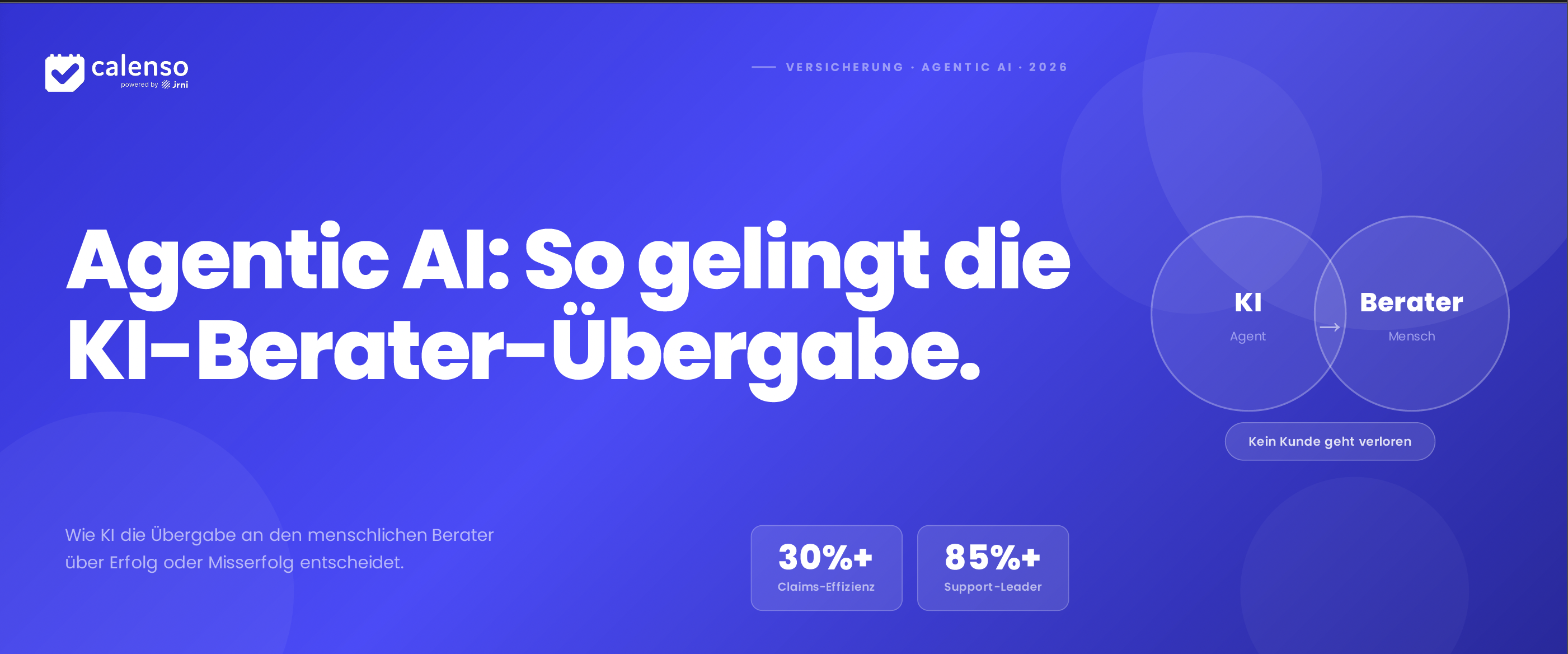

After a water pipe bursts, a customer reports the damage via the AI agent—the initial intake goes smoothly. Then the case becomes complicated: questions about coverage, an emotional tone in the conversation. The AI agent responds in a formulaic manner. The customer hangs up and cancels their policy tomorrow. Find out how insurance companies can handle this critical moment in this article—and in even greater detail in our free whitepaper, which includes a 4-step process, checklist, and ROI data.
Agentic AI is on the rise — but the key factor is being overlooked
Microsoft, Cognizant, and Salesforce are investing billions in AI-powered insurance customer service, while Sedgwick has already increased claims efficiency by over 30%. But the real key to success is often overlooked: it is not AI alone that determines the outcome, but the seamless handoff to the human advisor. This article shows how Swiss and DACH insurers are closing this gap—and why intelligent scheduling is the crucial bridge.
What does Agentic AI Insurance Customer Service mean?
Agentic AI refers to AI systems that can independently perform complex tasks across multiple steps without requiring human instruction for each individual step. Unlike traditional chatbots, which only answer predefined questions, AI agents can plan, make decisions, interact with external systems, and iteratively improve results.
In the insurance context, this means that an Agentic AI system can handle the entire claims reporting process—from the initial report through document review to claims reservation—completely autonomously. It can retrieve policy data from the core system, guide customers through an onboarding process via chat or phone, and provide a complete solution for simple inquiries without the need for a claims adjuster to intervene.
The key difference from previous waves of automation: Agentic AI is adaptive. It responds to unexpected situations, asks follow-up questions, and can dynamically adjust its workflow. This makes it particularly valuable for the insurance industry, where every claim has its own unique story. The distinction is clear, however: Agentic AI handles the routine tasks, while human expertise and empathy remain indispensable for complex, emotional, or legally sensitive situations.
Download the free white paper
Our free white paper shows exactly how insurance companies can close this gap, featuring a proven 4-step process, ROI data, and a practical checklist.
→ Download the white paper now
Insurance companies are increasingly turning to Agentic AI—with impressive results
The shift toward AI-powered processes in the insurance industry will have reached a new level by 2026. According to recent industry analyses, by the end of 2026, approximately 80% of all insurance companies will be using Agentic AI solutions in production, driven by the need to reduce costs and drastically shorten processing times.
The best-known current example comes from the partnership between Microsoft and Cognizant: claims specialist Sedgwick developed its “Sidekick Agent” using Microsoft Azure AI. The results are remarkable: claims processing efficiency increased by over 30%. Claims adjusters now receive relevant policy data in real time, along with automated document checks and decision support—tasks that previously required hours of manual work.
$47.1 billion— that’s how large the global market for agentic AI is projected to grow by 2030. Today, it stands at $5.1 billion. For insurance companies, this is no longer just a trend; it’s the new reality.
Cognizant complements this picture with its “Agent Foundry”—a platform that provides ready-to-use AI agents for claims, underwriting, and customer service and integrates seamlessly with existing systems. Salesforce is also positioning itself with Agentforce Insurance: AI agents that handle policy inquiries, claims submissions, and renewal offers fully automatically. According to the Deloitte Tech Value Survey, companies that have already implemented Agentic AI report measurable results in 70% of cases.

Switzerland's Digital Divide: Solid, but the Last Mile Is Missing
Digital maturity with gaps: 68% visibility, 55% customer experience
Swiss insurance companies are performing well on the international stage. However, a closer look reveals a structural problem: Wavestone’s Hybrid Sales Index 2025 rates Swiss insurers at a remarkable 68% in terms of digital visibility. When it comes to the actual customer experience across all channels, however, this figure drops to 55%—a gap of 13 percentage points.
The study shows that while Helvetia and Baloise are testing the first AI-based chatbots, simple, rule-based dialogue systems still dominate the market. The potential of generative AI and agentic AI remains largely untapped. At the same time, the Swiss Insurance Monitor 2024 shows that, according to a representative survey, 56% of the population living in Switzerland has already used AI applications, and 80% of respondents expressly want to be informed when AI is being used.
The last mile is missing—and that’s exactly where the customer experience falls apart
Customers are ready—even curious—about AI. But only if there is transparency and a human fallback option. The critical issue: Swiss insurers have laid the groundwork for automation, but the last mile is missing. This refers to the moment when AI reaches its limits: complex claims, emotional crisis situations, personalized life advice, and complaints. This is precisely where the customer experience breaks down—not because AI is bad, but because the transition to a human advisor isn’t organized.
The critical moment: When the AI agent is at a loss
In insurance consulting, there are a number of scenarios in which Agentic AI inevitably—and understandably—reaches its limits. These situations are not weaknesses of the system. Rather, they are intentionally planned handover points when the system is designed correctly.
Scenario 1: Complex claims with legal implications
Hail damage to multiple vehicles with unclear policy coverage, a disability claim involving overlapping claims, a cyberattack on an SME with a disputed coverage amount. In cases like these, automated rules aren’t enough. An experienced claims specialist must take over.
Scenario 2: Personal circumstances
A client who wants to review their life insurance policy after being diagnosed with a serious illness. A young family looking to restructure their coverage following the birth of their first child. By definition, these conversations require a high level of consultation and empathy.
Scenario 3: Escalation and Complaint Management
An upset customer after a payment was declined, or a long-standing customer relationship hanging in the balance. This is where a personal conversation and a smooth handoff make all the difference.
More than 85% of customer service managers cite a seamless handoff to a human agent as the main driver of customer loyalty in 2026. No matter how good AI may be, without a smooth handoff, its added value is lost.
Smart Scheduling as a Bridge Between AI and Consultants
Here lies the real unresolved question: How does the customer transition from the AI agent to the right human agent—without losing any information, without waiting on hold, and without having to re-enter their details? The solution is an intelligent system that connects the customer with the right agent at the right time.
Step 1: Automatic identification of the need for consultation
The AI agent detects when personal assistance is needed based on signals regarding customer sentiment, keywords, or process thresholds. This detection can be rule-based (“Complaint detected”) or AI-driven (“Frustration in the customer’s tone”).
Step 2: Smart Appointment Scheduling
Instead of a generic “We’ll get back to you,” the system immediately schedules a consultation with the right specialist—based on area of expertise (liability, life, health insurance, etc.), availability, and customer preference (phone, video call, branch). The customer chooses when and how they would like to be consulted.
Step 3: Full context transfer
Before the consultation, the advisor has access to the entire history of the interaction with the AI agent: claim details, forms that have already been filled out, the customer’s mood, and any unanswered questions. The customer doesn’t have to repeat a single word.
Step 4: Follow-up and Aftercare
After the consultation, the following steps are triggered automatically: appointment confirmation via email, a summary of the consultation, and automatic reminders for agreed-upon actions. Calenso offers exactly this solution: automated appointment booking as a bridge between AI and consultants. With an API-first architecture, the platform can be integrated directly into existing AI agent platforms, CRM systems, and core systems. The intelligent routing rules ensure that every appointment request is directed to the right specialist based on area of expertise, language, region, and availability. What sets Calenso apart from generic booking tools: The platform is hosted in Switzerland, fully compliant with the Swiss Data Protection Act (DSG) and the General Data Protection Regulation (GDPR), and is already in use by insurance companies in the DACH region. Sensitive customer data never leaves Swiss servers.
Free: The complete white paper on this topic
Would you like the complete 4-step process, including routing rules, a GDPR checklist, and an implementation guide? It’s all condensed into a 10-page whitepaper—available for free.
→ Download the whitepaper for free
Best Practices for Implementation in the Insurance Industry
The implementation of an AI-to-consultant handover system cannot be achieved through technology alone. It requires a clear conceptual foundation.
Clearly define routing rules
Define in advance which scenarios must be escalated to a human agent and what criteria trigger this automatically. Is the sentiment score below a certain threshold? Does the message contain the keywords “complaint” or “lawyer”? Is the amount of damages above a defined limit? The more precise the rules, the smoother the handoff will be.
Define context as a mandatory handover
Technically, it is possible to ensure a complete handover of context, but organizationally, this often fails due to internal silos. Establish a standard whereby no consultant receives a handover appointment without the full meeting notes and key data.
Incorporate customer preferences into the appointment booking process
Not every customer wants to speak on the phone right away. Giving customers the option to choose their preferred channel (phone, video, chat, or in-store) and time slot significantly increases the rate at which appointments are accepted and shows respect for the customer’s time.
Build GDPR compliance into the design from the very beginning
In Switzerland, the revised Federal Act on Data Protection (DSG) applies; in Germany and Austria, the GDPR applies. Customer data exchanged between the AI system and the consultant platform must be fully documented and designed to minimize data sharing. The scheduling platform should be natively compliant, not made compliant through retroactive modifications. You can find more information about GDPR-compliant features on the Calenso Features page.
Establish a learning loop
Handoff points are valuable data points: Where exactly does the AI agent leave its area of expertise? Which topics recur? This data helps to continuously improve the AI and highlights where training or process adjustments are needed.
Frequently Asked Questions About Agentic AI Insurance Customer Service
Conclusion: Agentic AI Insurance — the handover is key
Agentic AI is no longer a vision of the future. It is already a reality in the insurance industry. Sedgwick’s 30% increase in efficiency, Cognizant’s Agent Foundry, Salesforce Agentforce: the major technology partners have understood what is at stake. And yet, the central promise of Agentic AI—better customer service with reduced effort—can only be fulfilled if the handoff to a human agent is seamless.
Swiss insurers have a solid foundation for digitalization, but the last mile is missing. This last mile is not a technical problem. It is an organizational one: Who schedules the appointment? Which advisor is the right one? What does the advisor know before the meeting begins? Intelligent scheduling with consistent context handoffs bridges this gap. Companies that build it today secure a decisive competitive advantage: customers who aren’t left alone at the critical moment and therefore stay.
Ready for a seamless transition to an AI advisor?
In a free 15-minute discovery call, we’ll show you how Calenso automatically connects your AI agent with the right consultant—GDPR-compliant, hosted in Switzerland, and ready for immediate integration. You can find all the content from this post—plus a detailed checklist with six steps for successfully implementing Agentic AI—in our free white paper.
Sources
[1] Delivering on the Promise of Agentic AI Adoption in Insurance — Microsoft Industry Blog, February 2026
[2] From Bottlenecks to Breakthroughs: How Agentic AI is Reshaping Insurance — Microsoft Industry Blog, February 2026
[3] Wavestone: Hybrid Sales Index 2025 — Digital Insurance Maturity, via Netzwoche.ch, February 2026
[4] Swiss Insurance Monitor 2024 — AI Use and Transparency Expectations Among the Swiss Population
[5] Automation in the Finance and Insurance Sector — Digital Journal CH, March 2026
[6] Deloitte Tech Value Survey, October 2025 — Agentic AI ROI in Financial Services
[7] When to hand off to a human: Effective AI escalation rules — Replicant, 2026
[8] Calenso Features — calenso.com