
Imagine this: An advisor at your bank branch is waiting for his 2 p.m. appointment. The customer doesn't show up. No phone call, no cancellation—just an empty chair. What may seem like an isolated incident costs banks, insurance companies, and healthcare providers in the DACH region millions every year—through lost revenue, wasted capacity, and frustrated teams. In a market environment that rewards efficiency and customer satisfaction, this is not an acceptable status quo. The good news is that automated reminders, easy online rebooking, and data-driven tracking have been proven to reduce no-show rates by up to 70 percent. In this blog, you'll learn which seven strategies work in practice.
Why missed appointments cost companies millions
Missed appointments are much more than just an organizational nuisance. Every missed appointment means lost consultation time, lost revenue, and a decline in the utilization of valuable resources. In bank branches, consultation rooms remain unused; in insurance agencies, deals are delayed; and in doctors' offices, other patients have to wait longer.
The financial impact is significant—and well documented in the DACH region. German doctors and dentists report no-show rates of up to 30 percent [1], which the KBV confirms: up to 20 percent of patients do not show up for their appointments [3]. For dental practices alone, this means losses of up to €31,000 per year [2]. Applied to bank branches and insurance offices, the losses are likely to be proportionally comparable.
There are also indirect costs: employees lose motivation when appointments regularly come to nothing. The predictability of day-to-day business suffers. And customers who do not keep appointments are often more likely to fail to show up again next time—creating a vicious circle.
The good news is that the most common reason for no-shows is simply forgetfulness. According to a study by the University of Lübeck, over 60 percent of patients who did not show up said they had forgotten their appointment [4]—a problem that can be addressed directly with the right measures.
Up to 30% —that's how high the no-show rates are, according to recent surveys of German doctors and dentists. Source: arzt-wirtschaft.de / InterSystems [1]
Sources
[1] arzt-wirtschaft.de – Reducing no-show rates in clinics with AI (InterSystems, 2024):
https://www.arzt-wirtschaft.de/themenspezial-klinikaerzte/no-show-rate-in-kliniken
[2] dr-flex.de – No-show rates in doctors' offices (ZWP Online):
https://dr-flex.de/ressourcen/blog/no-show-rate-in-arztpraxen
[3] aerzte.de – No-show: What to do when a patient does not show up for their appointment (KBV, 2023):
https://www.aerzte.de/aerzteratgeber/ohne-absage-was-tun-wenn-der-patient-nicht-zum-termin-kommt
[4] eTermio – Over 20% no-shows for doctor's appointments? (University of Lübeck):
https://www.etermio.com/no-shows-bei-aerzten-verringern-massnahmen/
The most common reasons for no-shows
Before you can effectively reduce missed appointments, it is worth taking a look at the causes. Malicious intent is rarely behind them. The most common reasons are surprisingly trivial—and that is precisely why they can be solved.
Forgetfulness is the number one issue. In a busy everyday life, appointments that were booked days or weeks in advance are simply forgotten. Without a timely reminder, the appointment remains invisible in the calendar.
Complicated rebooking processes are the second most common reason. When customers are unable to attend their appointment but have to call, wait on hold, and navigate through several steps, many simply decide not to show up at all—and not to cancel either.
Missing reminders exacerbate the problem. If you don't receive a text message, email, or push notification, you have no reason to actively engage with the appointment.
Frustration due to long waiting times also leads to no-shows. Customers who have had to wait a long time in the past despite having an appointment develop less commitment to future appointments.
7 strategies for reducing no-shows
But how can companies specifically reduce the no-show rate? There are proven strategies, but unfortunately, not all companies and organizations are using them yet.
1. Automated multi-channel reminders
The most effective way to prevent missed appointments is to use automated reminders—across multiple channels simultaneously. Studies show that automated appointment reminders lead to a relative reduction in missed appointments of 34 percent. Multi-channel reminders that combine text messages, email, and phone notifications achieve a reduction of as much as 30 percent [1].
34% fewer no-shows thanks to automated appointment reminders – and up to a 30% reduction with a multi-channel approach (text message + email + phone call).
Source: Prosper Healthcare [1]
The optimal timing: Send a first reminder 48 hours before the appointment, a second one 24 hours before, and a final one on the day of the appointment. This gives customers enough time to reschedule if the appointment no longer suits them.
2. Easy online rebooking instead of cancellation
One of the most surprising findings: 75 percent of customers are more likely to show up for their appointment if they have the option to easily rebook it online. The reverse conclusion is clear—complicated rebooking processes lead to customers simply not showing up instead of actively rescheduling their appointment.
Offer your customers a direct link to online rebooking in every appointment reminder. One click, one new appointment—no phone calls, no waiting on hold. This way, you can turn potential no-shows into postponed but attended appointments.
3. Waiting list management for slots that have become available
Even with the best memories, some customers will cancel. The decisive factor is what happens to the slot that has become available. Automated waiting list management immediately notifies waiting customers when an appointment becomes available. This keeps utilization high and ensures that no consultation window is lost.
This strategy quickly pays off, especially in areas of high demand such as mortgage advice in banks or initial consultations with insurance advisors.
4. Track participation and identify patterns
Data-driven work is the key to reducing no-shows in the long term. If you systematically record which customers show up and which don't, you will recognize patterns: certain days of the week, times of day, or customer groups may have an above-average no-show rate.
With this information, you can take targeted countermeasures—for example, by sending more reminders for high-risk appointments or by implementing overbooking strategies for known no-show times. Since the January 2026 update, modern scheduling solutions such as Calenso offer the option of marking appointments directly as "attended" or "no-show" [4]—a valuable basis for systematic attendance tracking.
5. Appointment confirmation with two-way communication
Instead of passively waiting for customers to show up, successful companies rely on active appointment confirmations. Customers are asked to actively confirm their appointment—with a click in a text message or email. Those who do not confirm are contacted again, or the slot is released for the waiting list.
This approach combines reminders with commitment and gives you an early indication of whether an appointment will be kept or not.
6. Flexible appointment options (video + on-site)
Not every customer is able or willing to attend a consultation appointment in person. Hybrid models that offer both on-site and video consultations significantly lower the barrier to entry. Virtual assistants and digital consultation formats can reduce no-shows by 30 to 50 percent.
Insurance and banking consulting in the DACH region in particular shows that customers who can choose between video and branch appointments are significantly more likely to attend their appointments. Omnichannel appointment booking thus becomes a strategic lever against missed appointments.
Practical tip: Offer the choice between on-site and video consultations for every appointment booking. This reduces the hurdle for customers who are unable to attend at short notice but still want to keep the appointment.
7. Workflow automation for follow-ups
What happens if a customer does not show up despite all measures taken? Instead of simply writing off the incident, automated follow-up workflows should kick in: a friendly message to the customer with a new booking link, an internal notification to the consultant, and an entry in the CRM system.
This automation ensures that no customer is lost and that every no-show is used as an opportunity to re-establish contact.
How Calenso helps reduce no-shows
The strategies mentioned require a scheduling solution that can do more than just manage calendar entries. To reduce the no-show rate, Calensooffers an integrated system that has been specifically developed for the challenges of appointment-intensive industries:
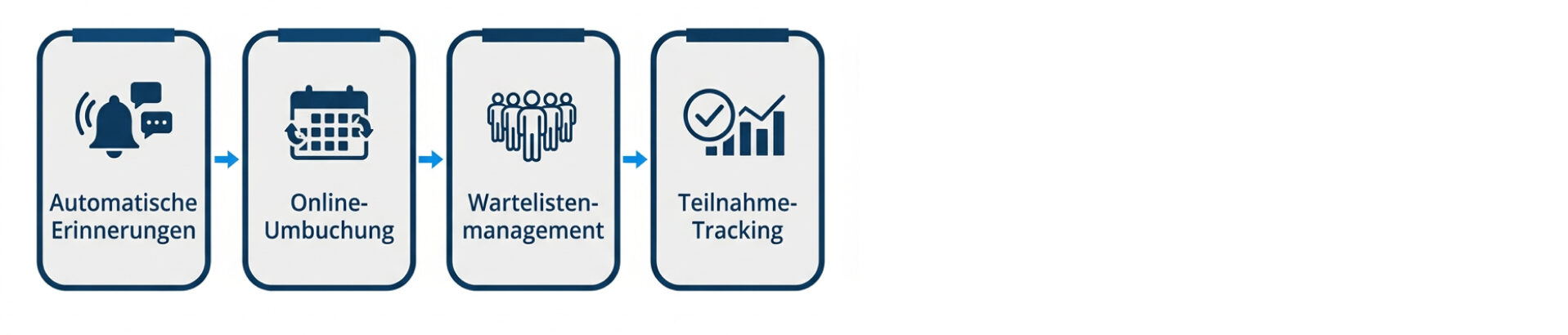
- Automatic multi-channel reminders via SMS, email, and push notifications—configurable in terms of timing and content
- Online rebooking with one click – directly from the appointment reminder, without a phone call or waiting on hold
- Waiting list management – slots that become available are automatically assigned to customers on the waiting list
- Participation tracking – since the January 2026 update, appointments can be marked as "attended" or "did not attend" [4], enabling data-based no-show analysis.
- Workflow automation – Smart Actions enable automatic follow-ups in case of no-shows
Companies such as Helvetia and Sanitas are already relying on integrated omnichannel appointment booking and benefiting from measurable results in reducing missed appointments.
Conclusion: Missed appointments are avoidable
No-shows are not an unavoidable evil, but a solvable problem. The combination of automated reminders, easy rebooking, intelligent waiting list management, and data-based tracking forms an effective shield against appointment cancellations. Companies that consistently implement these strategies can reduce their no-show rate by up to 70 percent—thereby increasing consultation time, revenue, and employee satisfaction at the same time.
The key lies in automation: the fewer manual steps required, the more reliable the measures are. Investing in a well-designed scheduling solution quickly pays off, especially for banks, insurance companies, and healthcare providers in the DACH region, which coordinate dozens or hundreds of appointments every day.
Ready to reduce your no-show rate?
In a free 15-minute discovery call, we'll show you how you can sustainably reduce your appointment cancellations with automated reminders, online rebooking, and intelligent tracking.
Book a discovery call now →Sources
[1] Prosper Healthcare: Reduce No-Shows Healthcare Guide
https://www.getprosper.ai/blog/reduce-no-shows-healthcare-guide-75dfc
[2] Sirius Solutions Global: Virtual Healthcare Assistants – No-Shows & Adherence 2026
https://www.siriussolutionsglobal.com/post/virtual-healthcare-assistants-no-shows-adherence-2026
[3] Healthcare IT Today: How to Reduce No-Show Appointment Rates in 2026
https://www.healthcareittoday.com/2026/02/05/…
[4] Calenso: January 2026 update
https://calenso.com/en/blog/calenso-januar-update-2026/
[5] Calenso: Features overview
https://calenso.com/alle-funktionen