

Imagine this: A customer searches for a consultation appointment on your website, switches to booking via the app, and shows up at the branch—without your team knowing what the appointment is about. No context, no preparation, no clear thread. For many banks with fragmented booking channels, this is an everyday occurrence.
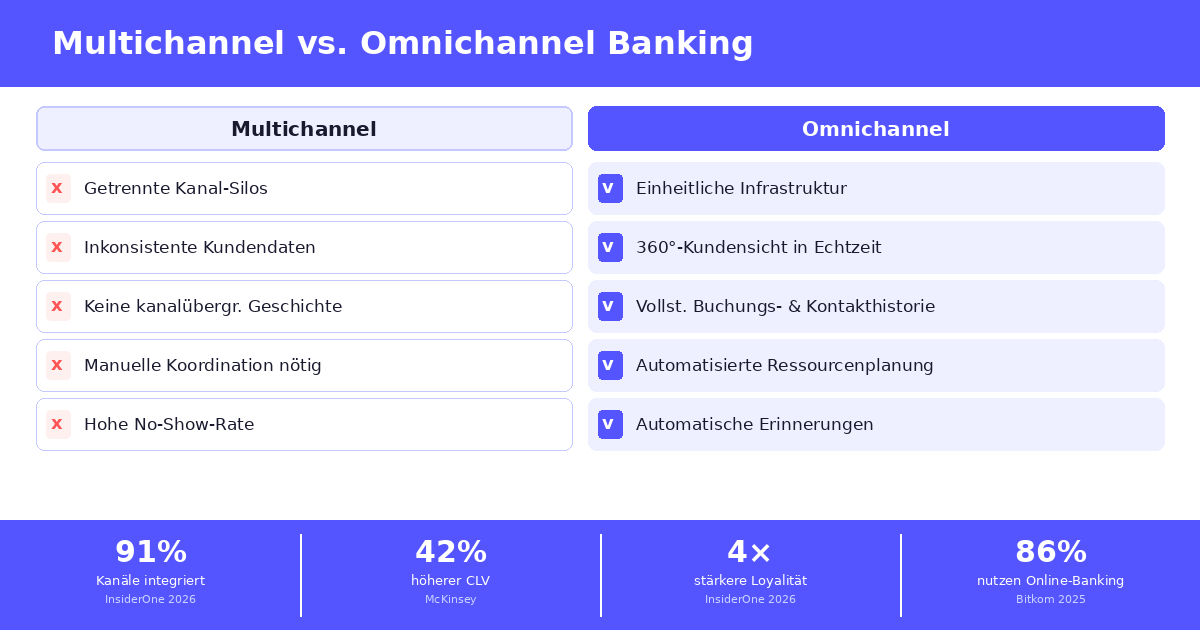
Omnichannel appointment booking for banks is the answer: a unified, cross-channel booking infrastructure that connects websites, apps, branches, phone calls, and video calls. 91% of financial institutions are already planning to integrate these channels [1]. Those who act now will secure a clear competitive advantage.
In this article, you’ll learn why fragmented appointment booking costs customers, how omnichannel works in practice, and how to successfully implement it.
Why Omnichannel Is No Longer Just a Buzzword for Banks
It’s clear from the numbers: 90% of bank customers expect a consistent experience across all channels —whether they visit a branch, use the banking app, or go to the website [1]. This makes it clear: it is no longer a nice-to-have, but a basic requirement for customer loyalty.
Even more striking: Banks that have achieved a high degree of channel integration are four times more likely to believe that customer experience is the key driver of loyalty and deposit retention [1] — compared to institutions that still operate isolated channels. In addition, omnichannel customers have a 42% higher customer lifetime value than purely single-channel customers.
At the same time, competition is intensifying: 86% of Germans already use online banking [2], and neobanks and fintechs are putting pressure on established institutions. Any cantonal bank, savings bank, or major bank that wants to survive must combine the digital convenience of these providers with the personal trust of a branch-based bank.
The Appointment Scheduling Problem: Fragmented Channels Cost Customers
Most banks today don’t have just one scheduling problem—they have many. An advisor takes appointments over the phone. The website has a separate contact form. The app shows branch locations but doesn’t allow for direct booking. And walk-in customers at the branch wait at the front desk without anyone knowing how long it will take.
These silos create friction on both sides. For customers, this leads to frustration: they have to call multiple times, wait for callbacks, or show up at the branch without an appointment—only to be put off. For the bank, this leads to inefficiency: advisors are unexpectedly tied up, resources are misallocated, and there’s no clear overview of who is available where and when.
The result? Customers switch banks. Or they don’t even bother seeking out the consultation that would benefit both them and the bank—a silent loss of cross-selling potential.
What omnichannel appointment booking looks like in practice
A true omnichannel appointment booking system for banks consists of several interconnected booking channels that all access the same availability and resource database.
Website widget for direct online booking
The website widget is often the first point of contact. An intuitive booking form, embedded directly on the bank’s website, allows customers to schedule an appointment around the clock: select the type of consultation (mortgage, investment, account), choose a branch or advisor, and set the time and channel. The appointment is confirmed immediately, automatic reminders are sent, and no-shows decrease.
App integration via REST API
Many banks already have their own mobile banking app. The transaction system can be seamlessly integrated via a REST API—allowing customers to make transactions directly within the app without having to switch to an external browser. The context is preserved: Before the conversation, the advisor can see which products the customer uses and what they want to discuss.
Store Touchscreen for Walk-in Management
For customers who drop by the store on a whim, digital check-in systems on touchscreens offer the solution. The customer logs in, selects their reason for visiting, and the system assigns them to the appropriate advisor queue—complete with a wait time display. This makes walk-in visits manageable without disrupting the booking flow.
Video call for hybrid consulting
Hybrid consulting has established itself as a standalone channel. Video calls for initial consultations, follow-up meetings, or complex topics such as financial planning are now standard practice and must be just as easy to book as an in-person appointment at a branch. Calenso integrates video calls directly into the booking process, without the need for external meeting tools.
The generational divide: Digital AND in person
A common misconception in the banking industry is that younger customers only want digital services, while older customers prefer in-person branches. The reality is more complex—and actually presents an opportunity for banks.
67% of consumers under 40 want both digital convenience and in-person assistance from advisors when it matters [3]. The initial consultation for a mortgage loan? In person. Confirmation of an investment rebalancing? Via video or app. Checking your account balance? Online.
This means that the bank that seamlessly integrates all these channels of communication comes out on top, because it meets customers where they are. And at the same time, the fact that 72% of customers choose their bank largely based on the level of personalization [1]means that those who personalize across channels have a structural advantage.
Omnichannel Appointment Scheduling with Calenso
Calenso is a Swiss accounting platform designed specifically for regulated industries such as banking and financial services. At its core is a multi-client system that brings all accounting channels together on a single central platform.
| Feature | What this means for banks |
|---|---|
| Multi-channel booking | The website, app, store, and phone all access the same real-time inventory |
| Video call integration | Hybrid consultations can be booked directly, without the need for external tools |
| Resource Planning | Consultants, rooms, and equipment managed centrally — no double bookings |
| Automatic reminders | Text messages, email, WhatsApp — No-shows are dropping significantly |
| Swiss Hosting & GDPR | Data sovereignty ensured for regulated financial institutions |
| REST API & Integrations | Integration with CRM, core banking systems, and existing websites |
You can find more information about specific solutions for banks and financial service providers directly at calenso.com.
4 Steps to Omnichannel Appointment Booking
The good news is that you don’t have to overhaul everything at once. A successful omnichannel rollout follows a proven phased approach—from the first quick win to full channel integration.
Assessment: Taking Inventory of Channels and Systems
Document all existing touchpoints: phone, website forms, branch processes, and the app. At the same time, identify which systems are already in place—CRM, core banking, and calendar tools. This overview serves as the foundation for any integration planning and prevents duplicate work later on.
Set up the booking platform and activate initial availability
Set up the central booking platform: Add advisors, consultation types (mortgage, investment, account), and resources (rooms, video links). Enable automatic confirmations and reminders via email and text message—this alone measurably reduces no-shows and can be up and running in just a few days.
Connect channels step by step — website first, then app and store
Get started with the website widget: a single code snippet that can be integrated in just a few hours and enables online bookings right away. The next step is to connect the app via the REST API. Finally, branch touchscreens and phone bookings are connected to the same database—all channels now access the same availability data.
Train the team, launch the pilot phase, and measure KPIs
Start by rolling out the system in one or two locations. Train your consultants on the new interface and automated processes. Track metrics from the very beginning: booking rates by channel, no-show rates, and customer satisfaction after appointments. After 4–6 weeks, you’ll have enough data to roll out the system to all locations—and concrete figures that will convince your internal stakeholders.
Frequently Asked Questions About Omnichannel Appointment Booking for Banks
Conclusion: Omnichannel appointment booking as a competitive advantage for banks
For banks, omnichannel appointment booking isn’t just a nice-to-have technical feature—it’s a strategic lever for customer loyalty, efficiency, and growth. 91% of financial institutions have recognized that full channel integration is the foundation of modern banking. Those who act now will gain a competitive edge—those who wait risk losing customers to competitors who are already delivering a seamless experience.
The good news: Today, it’s easier than ever to implement. Cloud-based solutions can be rolled out in a modular way—from a website widget as a first step to full multi-channel integration. The path to seamless customer service starts with a single, easily bookable appointment.
Ready for omnichannel appointment scheduling at your bank?
In a free 15-minute discovery call, we’ll show you how Calenso connects your channels—from your website and app to your physical locations. For regulated financial institutions in the DACH region.
Sources
[1] Omnichannel Banking in 2026: 4 Steps for a Seamless Customer Experience — InsiderOne
[2] Online banking hits new high – Bank branches under pressure — Bitkom e.V.
[3] Top Banking Trends for 2026 — Capgemini Research Institute
[4] Omnichannel Banking Solutions — Backbase
[5] Calenso Features — calenso.com