
Appointment coordination is one of the biggest hidden time wasters in everyday business life. While employees send emails back and forth, synchronize calendars, and organize callbacks, valuable working time is lost—time that could be spent on strategic tasks, customer service, or business development. AI scheduling is changing this fundamentally: according to a global study by the Boston Consulting Group (BCG) with over 13,000 respondents, 58% of employees who regularly use generative AI say they save at least five hours per week. At the same time, the market for scheduling software is growing rapidly, and companies that are now turning to intelligent automation are securing a decisive competitive advantage.
Why manual scheduling is becoming obsolete
The figures speak for themselves: according to Fortune Business Insights, the global market for online appointment booking software was valued at around $546 million in 2025 and is expected to grow to over $1.9 billion by 2034, with a compound annual growth rate (CAGR) of 14.7%. This clearly shows that companies worldwide are replacing manual coordination processes with automated solutions.
The reason for this is obvious. In practice, manual scheduling means multiple email exchanges, telephone queries, double bookings, and forgotten follow-up appointments. In regulated industries such as banking or insurance, compliance requirements and documentation obligations add to the workload. All of this not only costs time, but also impairs the customer experience—because long waiting times and cumbersome booking processes no longer meet today's expectations.
Global market for scheduling software
$546 million
2025
$1.9 billion
2034
CAGR: 14.7%
What AI scheduling can do today
Modern AI scheduling goes far beyond simple online booking forms. The technology has advanced rapidly in recent years and now offers features that intelligently control the entire scheduling process.
Smart appointment suggestions
AI systems analyze availability, preferences, and historical data to suggest optimal time slots for everyone involved at the same time. This eliminates the typical back-and-forth when trying to find a date.
Automatic conflict detection
Overlapping appointments, missing resources, or room bookings are detected and resolved in real time before a problem arises.
workflow automation
From booking confirmations and reminders to follow-ups after the appointment, automated workflows ensure that no step is forgotten.
Seamless integration
Cloud-based solutions can be connected directly to existing CRM, ERP, and calendar systems. According to Fortune Business Insights, cloud solutions already account for the majority of the market share.
AI scheduling: Three use cases for enterprise companies
1
Banking: Automated coordination of consultation appointments
For banks, personal advice is a key differentiator. At the same time, coordinating customer appointments across branches, advisors, and specialists is extremely time-consuming. Intelligent scheduling enables customers to book online appointments around the clock, taking into account the availability of the appropriate advisor, the desired location, and the type of advice required. Automatic reminders and integrated video consultation options further reduce the no-show rate.
2
Insurance: Intelligent claims consultation planning
When damage occurs, speed is of the essence. Customers expect to be able to make appointments for damage assessment quickly and easily. AI-supported systems can speed up the entire process here: from initial contact to assignment to the right claims handler to appointment confirmation—including automated preliminary queries that collect relevant information before the meeting.
3
Healthcare: Resource-optimized practice planning
In healthcare, efficient planning of patient appointments is crucial for quality of care and cost-effectiveness. AI-based appointment scheduling takes into account not only the availability of doctors, but also treatment rooms, equipment, and preparation times. The result: less idle time, shorter waiting times, and better utilization of existing resources.
What you should look for when making your selection
Not every scheduling solution is suitable for enterprise requirements. When evaluating solutions, decision-makers should pay attention to the following criteria.
✓
Cloud-based & scalable
Must grow with the company—from individual teams to organization-wide implementation.
✓
API-first & integration-ready
Open interfaces for seamless integration into CRM, ERP, and specialist systems.
✓
GDPR compliant & secure
European or Swiss hosting – particularly relevant for regulated industries.
✓
Full automation
Not just managing appointments, but automating the entire process—from preparation to follow-up.
Calenso: Intelligent automation for scheduling appointments with Smart Actions
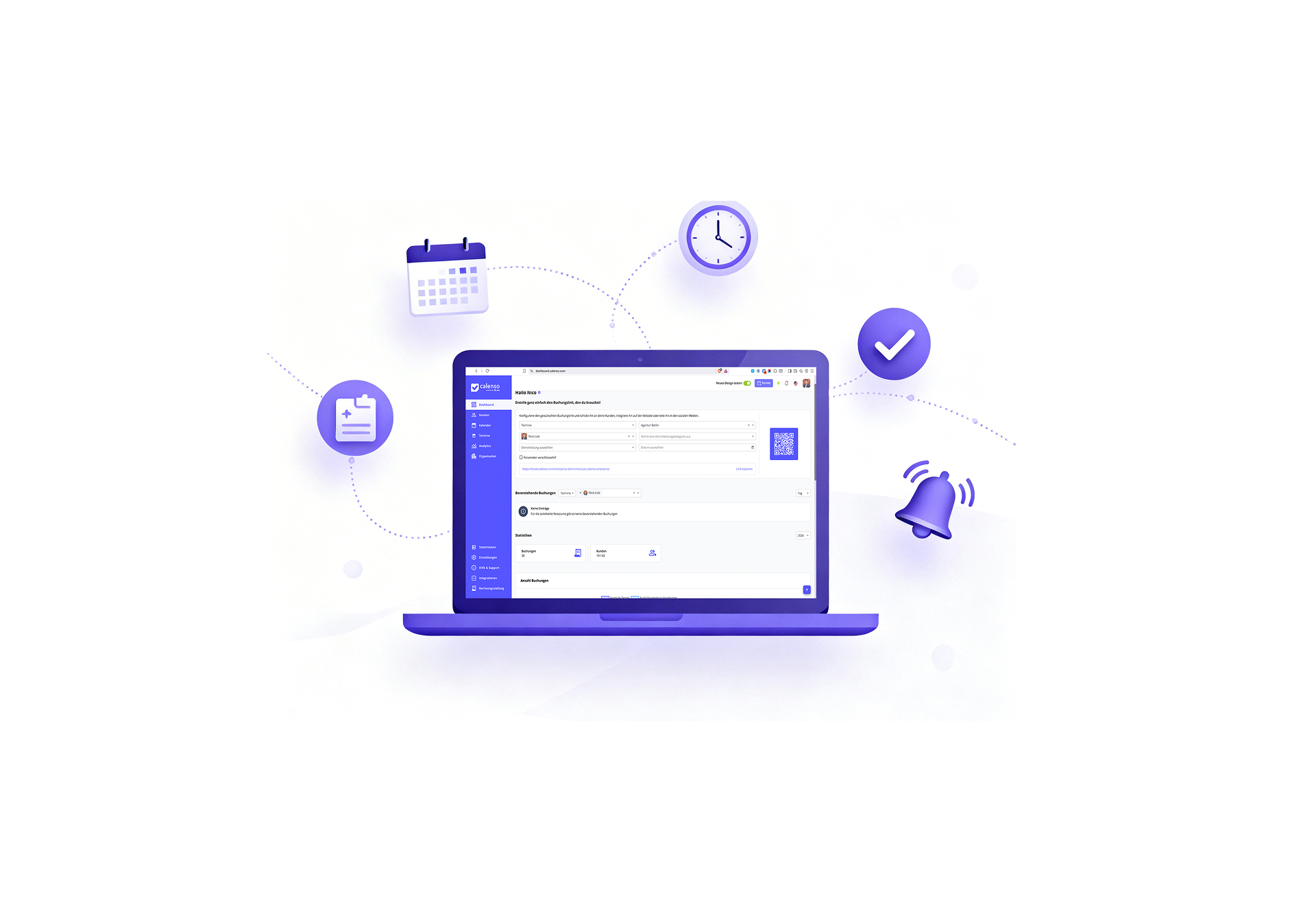
This is exactly where Calenso comes in—with AI-based scheduling. The Swiss platform for online appointment scheduling combines enterprise-grade security with intelligent automation—going beyond traditional scheduling tools.
With Smart Actions, Calenso offers automated tools that optimize the entire customer contact process surrounding appointments: automatic thank-you messages after appointments, feedback requests, reminders, and proactive appointment suggestions—all configurable and without any manual effort. Smart Actions are designed to be set up once and then work fully automatically in the background.
Since the January 2026 update, the official Zapier app has once again significantly expanded its capabilities: Over 5,000 app integrations are now available to automatically transfer booking data to CRM systems, marketing tools, or internal workflows. In addition, there are new waiting list triggers, improved Microsoft Teams integration, and granular configuration options for service blockages—all features designed specifically for complex enterprise scenarios.
The combination of ISO 27001-certified infrastructure, Swiss hosting, and comprehensive automation features makes Calenso particularly attractive for companies in the DACH region that have high data protection and compliance requirements.
Before – Manually
5h
Expense per week
✗ Double bookings
✗ Manual reminders
✗ Forgotten follow-ups
Afterwards – with AI
5h
earned per week
✓ Conflict detection
✓ Smart reminders
✓ Automated follow-ups
Conclusion: Regain time – starting now with AI Scheduling
The question is no longer whether AI-driven scheduling is coming, but how quickly your company will benefit from it. The market is growing at double-digit rates, the technology is mature, and productivity gains have been proven by studies. Five hours per week per employee. That's over 250 hours per year that can be freed up for value-adding activities.
The first step doesn't have to be a major transformation. Start with a clearly defined use case, measure the results, and scale gradually. With the right platform, manual appointment coordination becomes an automated process that reduces the workload for employees and delights customers.
Sources: https://www.bcg.com/press/26june2024-ai-at-work-survey-friend-and-foe
Would you like to learn how AI-driven scheduling could work in your company?
Discover how much time your team can save.